
Do Durability Test
0 Introduction
Durability test, also known as durability test, fatigue test and life test, is the test to determine the durability of products.At present, the main gap between many domestic hydraulic components and the world's advanced level lies in reliability. And the reliability of hydraulic components, mainly depends on the following two factors.
(1) Stability of manufacturing quality, or quality consistency. Stable quality can only be achieved through all the relevant employees conscientiously participate in the total quality management from the raw material storage to the product packaging factory, longterm persistence and im provement. It is achieved by strict and careful management.Some domestic hydraulic enter prises show off the imported high performance and high precision machine tools, at only most can provide necessary but not sufficient guarantee for the stability of the geometric size of the processing parts.
(2) Excellent design performance. Excellent performance includes not only those steady-state, dynamic characteristics, but also the durability that must be determined through prolonged, high- strength testing. At present, many hydraulic components in China are simulated by surveying and mapping, and their geometric size is similar to the advanced level. Therefore,these general steady-state characteristics, such as flow-pressure differential performance, are not different from the advanced level. The big difference is durability.
Although there have been many research and theoretical calculation methods on the fatigue life of materials, due to the influence of many practical factors, finally, the durability of hydraulic components must be tested by practical tests. Through the durability test, we canknow the level that has been reached, find out the reason that affects the durability, so as toimprove.
Therefore, it is very important to do durability test well.To do a durability test, you need to do these preparations:
① Define the purpose of the test;
(2) In-depth analysis of specimens and applications;
③ carefully planned tests;
(4) Develop a detailed test plan.
Then, the careful test, sort out the complete report, can obtain a relatively wide reference value of data, so as to draw inferential examples, get twice the result with half the effort.
The more prepared you are, the lower the cost of the trial, the more smoothly the trial proceeds,and the greater the harvest.
The following aspects are discussed separately.
1 Purpose of test
Durability test has different purposes and different test schemes.
1) Reach the standard
The criterion test is to check whether the performance of the specimen meets the requirements of the standard under the specified working conditions and within the specified continuous working time. The Chinese machinery industry standard recommends durability tests for some hydraulic components (see Table 1).
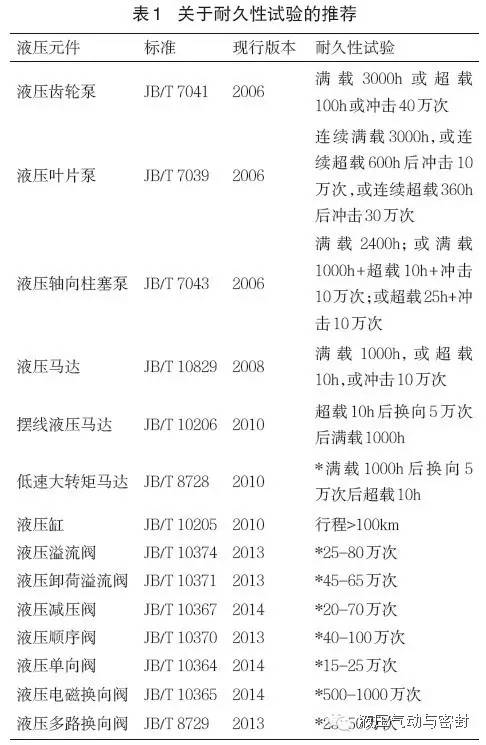
It is important that, before the durability test, especially after the durability test, the performance test should also be carried out on the specimen to check the impact of the durability test on the performance of the specimen.
This kind of test should usually be conducted by the quality inspection department independent of the R & D, design and manufacturing department, as long as the standard recommended working conditions and time, or the number of cycles.
This test is only done on batch products. Therefore, it can be said that it is a test between sample test and factory test, because, on the one hand, only for individual products, on the other hand, the specimen must have the characteristics of series products, that is, the materials, equipment and process used to make series products must be manufactured to truly reflect the characteristics of series products.
The working life depends on the geometric size of the product design, materials, technology, quality management in the manufacturing process and other conditions, therefore, in the design, process, material, corresponding management and other major changes in the durability of the product should be carried out again.
Must see:
(1) There are several international standards for the test methods of hydraulic components, but there is no international standard for the performance indicators that hydraulic components must meet. These test standards and methods implemented in the country, especially the performance indicators, were drawn up on the basis of our own experience.
(2) International companies will basically not implement China's test standards.
(3) At present, most high-end products in the Chinese market come from international
companies.
(4) Therefore, it can be logically inferred that in the Chinese market, many high-end products basically do not implement the Chinese test standards! In other words, it is possible to become a high-end product in the Chinese market without implementing China's test standards!
For example, the 2002 edition of JB/T10364, the industry standard for check valves, only developed the test method of durability test without giving specific indicators. The working
group discussion draft in 2010 recommended the number of tests to be 150,000-250,000 times. In 2010, a German company launched a check valve with engineering plastic spool seat up to 20 million times.
Another example is that the 2011 draft for consultation of JB/T10374, the industry standard for relief valves, recommends that the durability test is 250,000 ~ 800,000 times, while some German companies claim that their general test is 10 million times, and the refined one can reach 20 million times.
Again, for example, on the plunger pump industry standard JB/T7043-2006 version of the
recommended test time is 2400h, and there are German companies for the plunger pump for excavator commitment to use 8000h.
Again, there are foreign companies on its solenoid valve, flow valve, check valve and so on are one million times of 132% allowable pressure test, or 10 million times of 115% allowable press ure test.
(5) The performance indicators in the industry standards are often determined by the standard preparers in accordance with the general needs of the market at the time of the standard formulation and the possible level of the domestic manufacturing industry at that time. It will take at least two or three years for the standards to go through various levels of examination and verification before they are published. It is usually five or ten years before you revise it again. In the meantime, there will be new technologies, new materials and new processes, and the performance level will be improved.
Therefore, we must not rest on our laurels because of our standards.
2) Perform the contract
Check whether the products supplied to users meet the requirements agreed by both parties.
It should be noted that the durability requirements in the industry standards are universal. In fact, working life is a system engineering problem, and it depends on the application situation. Different application situations have very different requirements for durability. For example, a relief valve, used as a constant-pressure valve that is often opened, has very different durability requirements than a relief valve that is occasionally opened.Again, for example, hydraulic pump used in small impact occasions, such as cranes, and used in large impact occasions, such as excavators, durability difference is also very big. Therefore, it is more scientific and reasonable to carry out durability test and determine the life that can be used according to the application conditions required by customers.
In order to ensure the performance of the main engine in mass production, even if the per formance of the hydraulic component sample has met the requirements through the test, butalso a small batch trial, after that, will be ordered in large quantities, mainly is to worry about the durability of the components in actual use conditions.
Therefore, the hydraulic component manufacturer should take the initiative to go to the main engine factory, investigate the application occasions, test the load pressure of various practical applications, and then discuss with the main engine factory to formulate the loading scheme of durability test, so that the test condition can meet the actual needs of the main engine factory as far as possible. At the same time, the laboratory is open to the main engine factory, the mainengine factory can come to the laboratory at any time to examine the test condition, so as to obtain the trust of the main engine factory, it can speed up the pace of the main engine factory using the components.
This kind of test is usually conducted by the manufacturer's quality inspection department in cooperation with the purchasing department of the user, as long as the time or number of cycles agreed in the contract is met.
Simply submitting the newly produced samples to the host factory for durability testing has the following limitations:
(1) It is easy to achieve 24hour continuous operation on a test bench, while it is not so easy to test on the main engine;
(2) On a test bench, enhanced testing can be used, which involves concentrating the main conditions that affect the lifespan of the components, such as loading exceeding the rated operating conditions, high pressure, high speed, and high frequency, to obtain results in a relatively short period of time. However, when installed in the host, enhanced testing is difficult because it can cause abnormal loads on all parts of the host, and even cause safety accidents;
(3) Due to the fact that the duration of the test on the host may be as long as one or two years, it is not easy to achieve representative test conditions;
(4) On the host, if you don't try well and ruin your reputation, it will be difficult to recover in the future.
3) Comparison
Multiple samples, typically one of the advanced level and one of the newly developed ones, are placed in the same environment and test circuit under the same conditions and working conditions to find gaps, thereby improving the performance of one's own products, striving to surpass competitors, and competing for the market. Because when enterprises produce products, ultimately, they aim to gain a foothold in the market.
This type of experiment usually does not schedule a trial time, as long as convincing conclusions can be drawn.
4) R&D and Improvement
In the process of product development and improvement, conducting durability tests on samples can predict or verify weak links and dangerous parts of the structure, in order to improve the design or process level.
If the wear changes of the main friction pairs are measured simultaneously in the experiment, it can provide a basis for estimating the service life of the product.
This type of experiment is generally organized and conducted by the R&D department itself. Nowadays, it is increasingly being combined with modern design tools such as digital simulation and finite element analysis to improve efficiency and shorten research and development cycles.
The purpose pursued by many German enterprises is to continuously improve and achieve the best within their capabilities! For example, when conducting salt spray resistance tests on hydraulic pipe joints, domestically produced ones can generally reach 48 hours, with good ones reaching 96 hours. A German company developed a zinc nickel protective layer in 2011, which can withstand over 800 hours. But it doesn't stop. In 2013, it was claimed that it can reach over 1000h. The reputation of 'Made in Germany' was forged in this way.
The purpose of the test should be fixed in writing in the form of a test task book, test contract, research and development task book, etc., as a basis for further preparation of the test.
2. Analyze the test pieces and application scenarios
After the purpose of the experiment is clarified, it is necessary to conduct a thorough analysis of the test piece, its application situation, and the factors that affect its durability based on existing theories and experience. At this time, the test piece should not be regarded as a black box, as the deeper the analysis, the greater the gain.
Analysis can be conducted from the following aspects.
(1) The composition, structure, materials, and processing technology of the test piece.
(2) Function and working mode. The test pieces should have undergone general steady-state and dynamic tests, and their performance has been fully understood.
(3) Application occasions and requirements. The performance requirements vary depending on the application situation. For example, cylindrical compression springs wrapped with steel wires are the most common component in hydraulic components. If it is only used for resetting the valve core of ordinary solenoid valves, as long as the valve core moves and the spring is compressed, a certain resetting force can be generated, and its linearity and repeatability requirements are not high. If used in an electric proportional throttle valve, converting the electromagnetic force generated by the electric proportional coil into the displacement of the valve core, good repeatability and high linearity are desired. When used for overflow valves, the spring is compressed by adjusting the screw to generate elastic force, which acts on the valve core. At this time, the performance requirements are between the first two, hoping for good repeatability and less important linearity.
(4) Factors that affect durability. We should make guesses about various possible factors and their consequences by analyzing the application conditions in advance. For example:
① Wear of the mating pair exceeds the limit;
② Sealing ring wear and failure;
③ Spring fatigue fracture;
④ Component fatigue damage, such as cracking at the welding point of the hydraulic cylinder;
⑤ Material corrosion and aging, etc.
The event of loss of specified function during the test is called a malfunction, also known as failure. Faults can be divided into two categories:
One type of sudden failure is the failure of hydraulic components to function properly due to component damage, which can be called a hard failure.
Another type of failure is a gradual decline in performance below the minimum limit, such as poor sealing performance, gradual increase in leakage, and gradual changes in controlled pressure and flow rate, which can be called a soft failure.
Fatigue damage, usually a hard failure. Wear often causes soft faults.
If the product has been on the market for a period of time, the actual usage and any malfunctions should also be investigated. If it is a new product, similar products in the market can be investigated.
Before the experiment, it is necessary to visit the manufacturing department to inspect the production process and management level, understand the quality stability of the product, and determine the quantity and batch that should be inspected.
There is always a gap between practice and theory, so there may still be situations beyond conjecture in experiments. So, speculation cannot replace experimentation. And through experiments, we can make up for the shortcomings of experience and theory.
3 Planning Test Plan
On the basis of analysis, the entire experimental plan should be carefully planned. The planning should focus on the following aspects.
1) Are there any special requirements
For special environments such as low temperature, high temperature, high humidity, or other extreme conditions, existing testing conditions are insufficient and require design, manufacturing, and procurement, as this involves additional time and cost.
2) Proposed Test Method
Enterprise leaders hope that after the successful trial production of the new product, it can be put into the market as soon as possible and generate profits. But if its durability is poor and a large amount of damage occurs in a short period of time, especially during the shelf life, it will be a disaster for the enterprise, both economically and reputationally. Therefore, in order to obtain results as soon as possible, the durability test can also consider adopting reinforced test conditions:
① High voltage;
② High pressure fluctuations - periodic changes in pressure, almost sinusoidal or rectangular waves;
③ High frequency;
④ Even intentionally adding contaminated particles.
The time required for intensified testing is shorter than that of conventional testing, but whether the test results can be converted and how to convert them to durability under conventional working conditions is a problem that can usually only be mastered through a large number of comparative tests.
The test time should be calculated based on the predetermined number of cycles to estimate the ideal test cycle required.
3) Test system
The testing system should be as simple as possible, discarding all unnecessary components. Because almost all components in the entire system are undergoing durability testing. After an experiment, many components in the system may have to be scrapped. It may even occur that non test specimens are damaged before the test specimens, which affects the progress of the experiment. Therefore, using a socalled universal or comprehensive test bench for durability testing is extremely uneconomical.
Hydraulic components with complex structures and multiple factors affecting durability should be considered for decomposition and testing first. For example, a swashplate plunger pump has three friction pairs: oil distribution plate and cylinder body, piston and cylinder body, and sliding shoe and swashplate. Due to different force conditions, relative speeds, and lubrication conditions, the materials used and manufacturing processes used are also different. In companies with advanced levels in the world, durability tests are not conducted on the entire pump at once. Generally, suitable materials are searched for through wear testing machines, and the durability of the plunger under different conditions is studied through a single column plug test bench. The oil distribution plate and simulated cylinder body are loaded separately to study their durability. After gaining a lot of experience, the durability of the entire pump was tested.
4) Test circuit
The experimental circuit should focus on energy conservation. Due to the long experimental time, almost all of the energy invested is ultimately converted into heat, often requiring additional energy consumption for heat dissipation.
For example, for the durability test of hydraulic cylinders, both the national standard GB/T15622-2005 (6.4) and the industry standard JB/T10205-2010 (7.3.4) recommend that the tested cylinder be continuously operated at the maximum speed required by the design under rated pressure.
If, according to the test circuit recommended by the national standard (see Figure 1), the loading is completely dependent on the relief valves on both sides of the loading cylinder 11, and the energy is not recovered, then the power required for pump 2 (rated pressure) × The maximum flow rate is extremely high, and the pump that provides flow to the loading cylinder also requires a large flow rate. The entire system is extremely hot.
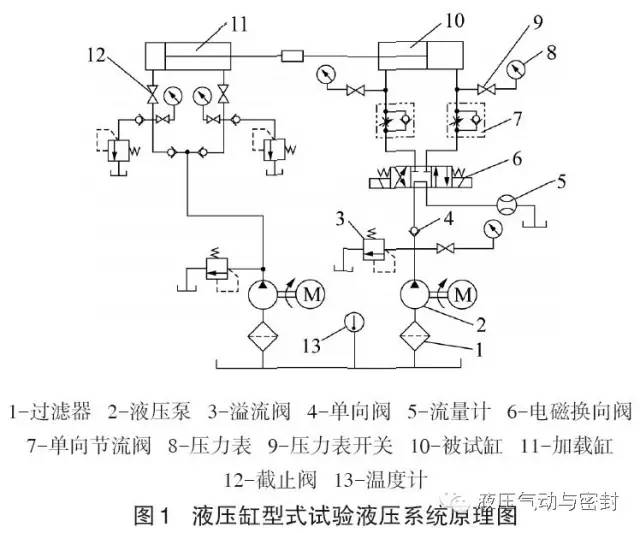
If this recommendation is adopted, but the circuit is changed to recover energy, although the operating cost of the test bench has been reduced, the circuit is more complex and the construction cost has increased.
If the hydraulic cylinder shown in Figure 2 is to be tested, the factors affecting its durability can be analyzed as follows.
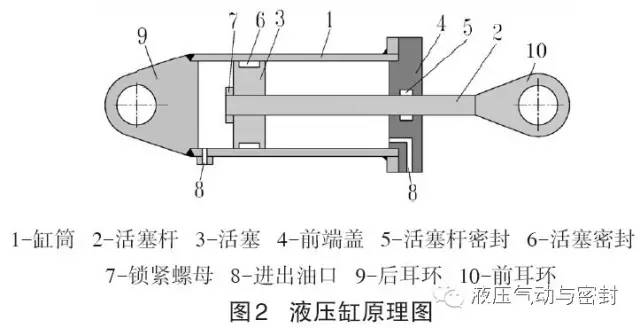
(1) The piston rod 2 of the cylinder is welded to the front ear ring 10, and the cylinder barrel 1 is welded to the rear end cover 9. The fatigue damage to the cylinder barrel, end cap, piston rod, earrings, and welding joints is caused by the alternating force of loading, independent of the piston movement speed.
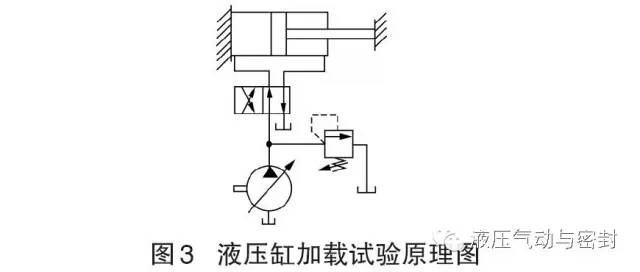
Therefore, the front and rear earrings of the hydraulic cylinder can be fixed to prevent it from moving; Fill the piston chamber and piston rod chamber with hydraulic oil, and use a two position four way solenoid valve to repeatedly load the two chambers at a higher frequency (see Figure 3). In this way, just a high pressure pump with a very small flow rate is sufficient, with minimal
energy consumption.
(2) The piston seal 6 and piston rod seal 5 are worn due to long term back and forth movement The degree of wear mainly depends on the roughness and load bearing area ratio of the inner wall of cylinder barrel 1 and the surface of piston rod 2, the wear resistance of the seal, and the stroke traveled, many of which are independent of the pressure on both sides. To investigate the effects of these factors, no loading is required, as long as a low-pressure and high-flow pump is used to quickly move the piston through its full stroke. In this way, energy consumption is also minimal.
The degree of wear of certain types of seals is also related to the pressure difference on both sides. For this, you can consult the sealing ring manufacturer or design a separate test bench to conduct comparative tests to obtain reference data for comparison.
By adopting these approaches, the construction and operation costs of the test bench can be greatly reduced.
5) Test pause criteria
The test suspension (suspension) criteria and corresponding detection methods should be determined based on possible faults: mechanical, hydraulic, electrical sensors, etc.
Some faults, such as wear, cannot or are difficult to detect during the testing process and can only be detected through the disassembly process. Therefore, it is necessary to determine whether to carry out partial or complete dismantling inspection, dismantling inspection items, observation parts, and dismantling inspection cycle. The inspection cycle can be shorter at the beginning and gradually extended later.
The purpose of planning is to develop a test outline for review by relevant parties.
If the test is indeed relatively simple and the conditions are relatively mature, you can skip the test outline and directly formulate the test plan.
4. Develop Test Plan
After the test outline is reviewed and approved, a test bench will be designed based on this and a detailed test plan will be developed. Pay attention to the following points.
(1) Complete technical documents of the test piece should be attached: name, code, drawings (assembly drawings, part drawings), materials, production process (including heat treatment process), etc.
It is required to conduct targeted and complete status records before the test: actual machining dimensions, shape and position deviations, hardness, roughness of the mating surface, etc. of the mating motion pair and sealing groove.
For example, the bottom of the sealing groove shown in Figure 4, although the machining size is within the allowable range, is not concentric with the outer circle, which can lead to different compression amounts on both sides of the sealing ring and premature failure in the test.
(2) The testing equipment should not only have timing and counting instruments, but also instruments that monitor the test pause criteria. When a soft fault is detected and the indicator is lower than the set value, or a hard fault is detected, the test should be immediately stopped.
(3) To set up automatic monitoring and control protection measures. It should be considered that in order to obtain results as soon as possible, durability tests are often conducted 24 hours a day, with most of the time unattended. During this period, all other components in the test circuit may also have problems, and various faults may occur, such as oil overheating, pipeline burst, motor burning, and so on. Therefore, corresponding monitoring, control and protection measures should be set up. For example, motor thermal relay, oil temperature monitor, cooler, oil tank oil level monitor, etc., an oil leakage storage disk is installed under the test bench. And design corresponding handling measures: such as automatically suspending the test and sending an alarm at the same time.
To avoid contamination of hydraulic oil by a large number of wear particles, especially during the strengthening test, multiple filters with high scale capacity should be installed. It is best to set up an online oil contamination level detector, as abnormal contamination is often a prelude to failure.
(4) To develop a test record form, at least the following items should be included: date, time, tester, number of cycles, and items to be observed (observation status).
(5) If there is a dismantling inspection, a dismantling inspection record form should be formulated, specifying which components and matching dimensions need to be sensory evaluated or measured.
5 Test report
The following points should be noted when organizing test reports.
(1) The name and code of the test piece, supplier, supply date, analysis and summary of test results, and suggestions (options) for improving the test should be arranged on the front page of the test report, so that leaders and those who do not need to know the test details can quickly see the test results.
(2) There should be detailed information about the test piece: drawings (assembly drawings, part drawings, including measured dimensions), materials, production (heat treatment) processes, etc.
(3) The testing system and circuit should indicate the location and code of the measuring points. It is best to attach photos of the testing device.
(4) Preserving the original handwritten test record form and original disassembly record form can increase the credibility of the experiment.
(5) The record of test pauses or interruptions should be truthful and detailed: the time of the malfunction, the number of cycles, the phenomenon of the malfunction, which part has what malfunction, and the troubleshooting measures. These are extremely valuable for improving the design of the tested parts.
(6) It is generally required that the test report should include suggestions for improvement of the test piece. Actually, this should not be written by the experimenter. Because conducting experiments is like being a judge, demanding fairness and objectivity. It is the coach's job to provide improvement suggestions. Being both a referee and a coach can often affect fairness.
The more complete the test report, the greater the reference value. Because the materials are the same, the processing technology is the same, the size matching is similar, and the stress is similar, then the durability should also be similar. Even a world-class enterprise cannot conduct durability tests on all of its products, many of which are determined by analogy.
Conduct durability tests to improve the level of domestic hydraulic components!
(Author:张海平)
reference:
[1] GB/T 15622-2005, Hydraulic Cylinder Test Methods [S]
[2] ISO 10100:2001,Hydraulic Fluid Power-Cylinder-AcceptanceTest[S].
[3] Lu Yongxiang Hydraulic and Pneumatic Technical Manual [M] Beijing: Mechanical Industry Press, 2007
[4] Xiong Shibo. Hydraulic Testing Technology [M]. Beijing: Mechanical Industry Press, 1982
[5] Zhang Haiping. Testing is the Soul of Hydraulics [J]. Hydraulic Pneumatic and Sealing, 2010,
[6] Wang Yiqun, Gao Dianrong Technical Manual for Hydraulic Engineers [M] Beijing: Chemical Industry Press, 2010
[7] Zhang Haiping Hearts from the 2013 Hanover Industrial Expo [J]. Hydraulic, Pneumatic, and Sealing, 2013, (10)
Powered by:手机电脑极速建站15318973126sitemap