
The Development Trend of Hydraulic System Industry and the Opportunity Challenge Barrier Composition
1、Basic concept of hydraulic system
Hydraulic system is according to the PASCAL principle of fluid mechanics, to the liquid as the working medium, to the liquid internal pressure can carry out power (or energy) transfer, conversion and control of the transmission system, hydraulic system is the key to control mechanical equipment to complete various actions, its technical level and product performance will directly affect the degree of automation and reliability of mechanical equipment.
The hydraulic system is generally composed of five parts, including power components, control components, executive
components, auxiliary components and working media, as follows:
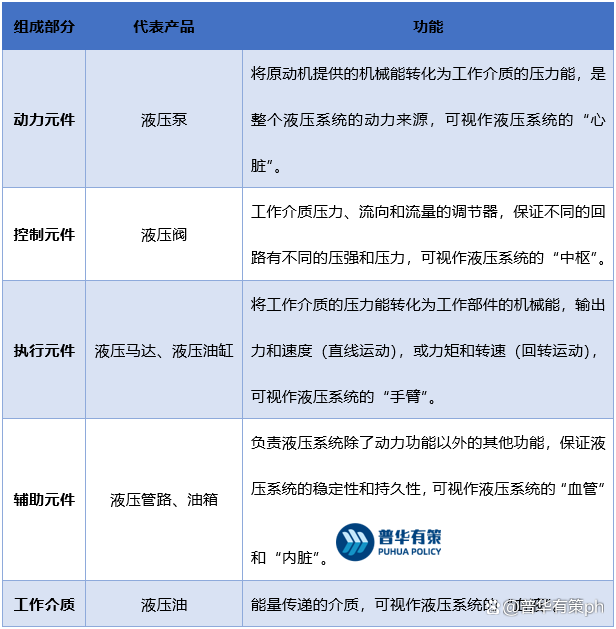
The working principle of the hydraulic system is generally: the prime mover drives the hydraulic pump, the hydraulic pump pumps into the hydraulic pipeline, the hydraulic valve controls the flow rate and pressure of the hydraulic oil, so as to adjust the reciprocating speed and direction of the hydraulic cylinder.
Compared with mechanical transmission and electric transmission, the hydraulic system has irreplaceable advantages:
(1) under the same power, the hydraulic system device has large capacity, small volume and small mass. For example, the output of the same power, the mass of the hydraulic motor is only 10%-20% of the mass of the motor, but also can transfer large force or torque;
(2) Easy to achieve large transmission ratio transmission, speed control range is large, can conveniently achieve stepless speed control in operation, while low speed performance is good;
(3) Easy to achieve rotary and reciprocating linear motion, the system is easy to arrange;
(4) The system control and adjustment are relatively simple, easy to realize mechanical automation;
(5) Simple operation, smooth work, quick response, small impact, easy to frequent, quick steering and start;
(6) Safe and reliable work, easy to realize overload protection when the hydraulic system is overloaded;
(7) hydraulic transmission with oil as the working medium, components can be self-lubricating, easy maintenance.
Based on the above advantages, the hydraulic system is widely used in all kinds of host products and technical equipment in various industries, such as construction machinery, mining machinery, port machinery, agricultural machinery, metallurgical machinery, automobile industry, machine tools and other fields.
2、Development trend of hydraulic industry
(1)The import substitution trend of high-end products appears
Although our hydraulic industry is developing rapidly, but for a long time most of the hydraulic parts production enterprises are
small, limited innovation ability, hydraulic products are mainly concentrated in the middle and low-end products, a large number of excess capacity of ordinary hydraulic parts, low price and low level of product competition. As the development of high-end
hydraulic parts lags behind the downstream equipment manufacturing industry, domestic host manufacturers need high-end
hydraulic parts for a long time to rely on imports.In recent years,with the development of the and the technological innovation
of enterprises, the domestic hydraulic parts manufacturers have made breakthroughs in technology and technology, and the product performance has been improved. Some highquality enterprises in the hydraulic industry have gradually broken the dependence of domestic Oems on international brands and expanded their market share by virtue of the high cost performance and regional advantages of their products. The outbreak of the novel coronavirus in 2020 hindered international trade to a certain extent, and domestic host manufacturers actively sought domestic enterprises for supporting, which promoted the process of import substitution and provided new opportunities for domestic hydraulic parts manufacturers.
(2)Hydraulic technology combined with high-tech achievements
In recent years, the integration of hydraulic technology with computer information technology, microelectronics technology, automatic control technology and other new technologies has promoted the development level of hydraulic system and components. In the short term, the possibility of breakthrough changes in hydraulic technology is low, but the hydraulic technology will continue to improve, specifically as follows: hydraulic components miniaturization, lightweight, modular; Green production process; Hydraulic system integration and integration.
1)Product miniaturization, lightweight and modular
Miniaturization, lightweight and modularization are the inevitable trend of the whole hydraulic industry. Through the redesign of
component layout and structure, the miniaturization of hydraulic components is beneficial to improve the response speed of
hydraulic system. Lightweight hydraulic components can be realized through the selection of materials and technological update. Lightweight hydraulic components can reduce the energy consumption of downstream machinery and equipment, extend the
service life, and improve production efficiency. The modularization of hydraulic products refers to the technical means of integrating the functions previously realized by multiple parts into one module, so that a single module can replace multiple parts. The modularization of hydraulic products can improve the assembly efficiency and improve the sealing of hydraulic products.
2)Green production process
The process pollution of hydraulic components and parts in the manufacturing process, vibration and noise of products, material
loss, media leakage and so on are important challenges faced by our hydraulic industry. In the future, green manufacturing
technology needs to be applied to the whole life cycle process of product design, process, manufacture, use and recycling. The
vibration and noise of hydraulic products and systems are reduced by structural optimization technology and active control
principle. Step out of environmentally hazardous manufacturing processes, adopt environmentally friendly manufacturing methods and equipment, and improve the utilization of resources and energy in the manufacturing process; Develop new materials that reduce friction and hydraulic component use loss to improve material utilization; Through the development of hydraulic pipeline connection technology, research and development of new sealing materials, optimize the sealing structure and finishing process, improve product sealing performance, reduce media leakage and pollution; Development of fluid media recovery processing and reuse process, development of special hydraulic components disassembly, recovery, remanufacturing process, improve product recycling.
3)Hydraulic system integration and integration
The hydraulic system integration and integration can realize the flexibility and intelligence of the hydraulic system, give full play to the advantages of large transmission output, small inertia, fast response and so on. With the development of new energy technology and intelligent equipment, terminal application requires the effective combination of hydraulic transmission technology and electronic control technology, change the traditional control form, improve the response performance of the system. Industry needs to break through the traditional bondage, promote the research and development of intelligent and integrated systems, and meet the future Chinese market demand for hydraulic products. Hydraulic system integration and integration is the future development direction of hydraulic industry.
3、Opportunities facing
(1)National industrial policy support
In recent years, the state attaches great importance to the development of hydraulic industry and has issued a series of policies
to encourage development. According to the "Made in China 2025" issued by China in 2015, hydraulic parts belong to the core basic parts of industrial strong base engineering. Made in China 2025 clearly states that by 2025, 70% of core basic parts and components and key basic materials will be independently guaranteed, 80 iconic advanced technologies will be popularized and applied, some of them will reach international leading levels, and a relatively complete basic service system for industrial technologies will be established. Gradually form an industrial innovation pattern of coordinated interaction between machine traction and foundation support. It is proposed in the "14th FiveYear Development Plan Outline" of Hydraulic and Pneumatic seal Industry that by 2025, more than 80% of the high-end products of hydraulic and pneumatic tightness will realize independent protection Therefore, the demand for high-end hydraulic parts is urgent.
Guided by the above national policies, some leading mainframe industries have gradually reformed the parts procurement system, allowing domestic highquality enterprises to enter the list of qualified suppliers to realize the localization of parts procurement. With the continuous expansion of the global share of host manufacturers, some highquality domestic enterprises can grasp the development opportunities of import substitution of key parts in the hydraulic industry by virtue of product research and development ability, their own scale advantage and stable product quality. Therefore, the implementation of import substitution policy will provide a broader development space for leading enterprises with independent research and development capabilities in the industry.
(2) The development of downstream industry provides broad market space for hydraulic industry
Hydraulic component is an important basic industrial product, downstream application field is wide. Along with the development ofour national economy, the acceleration of urbanization construction, industrial upgrading and structural adjustments, construction machinery, automobile industry, heavy machinery, agricultural machinery, Marine industrial and high-end equipment will achieve steady and rapid development in the process of our country's transformation from a manufacturing power to a manufacturing power. Bring broad market demand for hydraulic products.
4、Challenges faced
(1)Domestic raw materials and accessories can not meet the demand
The main raw materials required by hydraulic components are steel pipes. On the one hand, most domestic steel pipes are standard models, and their technical parameters cannot meet the customized needs of high-end hydraulic components. On the other
hand, due to the weak industrial base of our country, in addition to the products of some leading iron and steel enterprises, most
domestic steel pipe impurity content and performance index gap with imported steel pipe, domestic high-end raw materials
supply is insufficient, leading to the dependence of high-end hydraulic parts raw materials on imports. Therefore, at present, the
performance defects of domestic basic raw materials and accessories and the insufficient supply of domestic high-end raw
materials have become the main restricting factors for the quality improvement of high-end hydraulic products.
(2) The international market has insufficient recognition of the domestic hydraulic industry
Since foreign hydraulic industry started earlier and the overall technical level is higher, the high-end market of domestic hydraulic
parts is mostly occupied by international giants at present, and the products of Chinese hydraulic industry are concentrated in the middle and low end of the value chain. As a result, international host manufacturers have low recognition of domestic hydraulic
parts manufacturers, and there are obstacles for domestic hydraulic parts manufacturers to enter the supplier system of
international mainstream manufacturers. It is more difficult to participate in international competition.
5. Industry entry barriers
(1) Research and development and technical barriers
Because different hosts and even different parts of the same host have different demands on the shape and size of pipes, hydraulic parts manufacturers often need to carry out personalized design and production according to the specific needs of customers.
In addition, with the continuous improvement of the degree of industrialization and the continuous iteration of technology,
downstream customers on the service life of hydraulic components, reliability, stability and other performance requirements are
increasingly high.
The technical capabilities of the research and development, design, production and testing of the abovementioned hydraulic
products need longterm experience accumulation to gradually improve and mature. It is difficult for new enterprises in this
industry to form stable process control and process control capabilities in a short time, so the research and development
capability and production technology level constitute the barriers to entry of the hydraulic industry.
(2) Market development barriers
Hydraulic pipeline as a transmission device to ensure the operation of the hydraulic host, just like the blood circulation system of
the host. The quality of hydraulic pipeline directly determines the stability, fluency and life of the main engine. Therefore, the host manufacturer will strictly select the hydraulic pipeline suppliers, and the products need to go through strict testing when selecting suppliers. In addition to meeting audit standards, relevant products also need to pass the actual use evaluation. Therefore, once
the cooperation relationship is determined, host manufacturers in order to ensure the stability of their product quality, will not
easily change suppliers, so there is a certain customer stickiness. Generally speaking, hydraulic parts enterprises that maintain a good brand reputation for a long time have great advantages in obtaining customer orders and establishing stable cooperative
relations. For new entrants, it is difficult to establish market reputation and form brand effect in a short period of time, so there are certain market development barriers in the hydraulic industry.
(3) Capital and scale barriers
Hydraulic industry is a capital-intensive industry, the production of hydraulic parts needs large-scale fixed assets investment,
including plant construction, equipment purchase and other capital investment. The production efficiency and product
performance, stability, service life and other indicators of hydraulic enterprises largely depend on the configuration level of
production equipment. In the cost composition of hydraulic products, raw materials account for a relatively high proportion. The
production needs to purchase raw materials such as steel and castings, and the production turnover needs a large amount of
working capital, which is also an important part of the capital investment in the hydraulic industry. In addition, only enterprises with a certain scale can form scale effect, so as to effectively reduce production costs. Therefore, new entrants must have strong
financial strength and scale.
(4) Talent barrier
With the acceleration of technological innovation in the hydraulic industry, the research and development and production of hydraulic parts involve interdisciplinary technology and manufacturing process. Enterprises need to have a high-level research and development team and technical personnel, but also need skilled production technology workers and experienced inspectors, in order to ensure the sustainability of research and development, advanced manufacturing level and stability of product quality. At present, there is a shortage of professional talents for high-end hydraulic parts in China. To establish a professional and reasonably structured talent team through the enterprise's own training, it needs to go through continuous technology accumulation and market precipitation. It is difficult for new entrants to deploy professional talent teams in a short period of time. Therefore, the hydraulic industry has a certain talent barrier for new entrants.