
Hydraulic Industry Development Trend Competition Pattern and Development Trend
There is still a big gap between Chinese local hydraulic enterprises and foreign advanced enterprises in terms of production technology. Most of the hydraulic products produced by local hydraulic enterprises are in the middle and low end of the value chain. The development of high-end hydraulic components lags behind the downstream equipment manufacturing industry. Domestic host manufacturers cannot purchase high-end hydraulic products from local hydraulic enterprises, resulting in a large number of high-end hydraulic components need to rely on imports.
In 2019, 2020 and 2021, China's total imports of hydraulic products were $3.15 billion, $3.17 billion and $3.57 billion, respectively; in 2019, 2020 and 2021, the total exports of hydraulic products were $1.40 billion, $1.26 billion and $2.11 billion, respectively. The amount of imports far exceeds the amount of exports. If some hydraulic components produced by domestic hydraulic enterprises are considered for export market, the domestic supply gap will be further expanded.
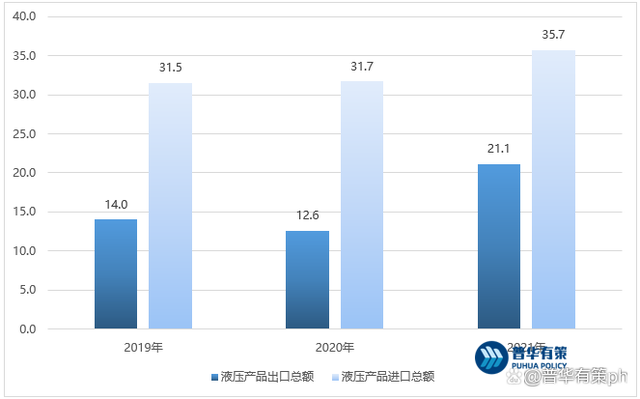
Source: China Hydraulic and Pneumatic Seal Industry Association
In 2021, the hydraulic component with the largest distribution of production value of key enterprises in China's hydraulic industry is hydraulic cylinder, accounting for 35.6%, while the production value distribution of products with high technical difficulty and high added value, such as hydraulic valves, hydraulic pumps and hydraulic motors, accounts for relatively little. Hydraulic valve, hydraulic pump and hydraulic motor are the key fields that need to be localized in China's hydraulic industry.
1、Industry competition pattern
From a global perspective, the hydraulic industry market concentration is high, Germany, the United States, Japan's hydraulic industry in the world to maintain the lead, Germany's Bosch Rexlux, Parker Hannifin, Eaton, Japan's Kawasaki Heavy Industries and other multinational enterprises have a considerable production scale and technical strength, hydraulic components product variety is more complete, It covers cylinder, motor, pump valve and other valuable hydraulic components. At the same time, there are a number of large-scale enterprises such as Hydac as the first level supplier to provide supporting services for hydraulic system manufacturers. However, China's hydraulic industry started late, and domestic hydraulic enterprises generally have problems such as small scale, low market concentration, lack of high-end hydraulic products, and their technical level and scale still lag behind that of foreign countries.
Although there is a big gap between Chinese hydraulic enterprises and international hydraulic enterprises, with the support of national policies, relying on national major projects and key projects, some domestic hydraulic enterprises continue to strengthen technology research and development and capital investment. After years of accumulation, they have a certain competitive advantage in the hydraulic subdivision industry, and have the ability to match with the main engine factory. Further shorten the gap with foreign famous brand enterprises, but overall still can not meet the needs of domestic and foreign markets.
2、Opportunities facing
(1)Strong support from national industrial policy
As an important supporting industry of equipment manufacturing industry, China attaches great importance to the development of hydraulic industry, In recent years, the state has successively issued policies such as "Made in China 2025", "The 14th Five-Year Plan for National Economic and Social Development and the 2035 Vision Goal Outline", "The 14th Five- Year Development Plan Outline for the Hydraulic and Pneumatic Sealing Industry",and put forward key core technologies in the fields of concentrated superior resources, components, components and basic materials. We will carry out industrial infrastructure reconstruction projects, and speed up the replenishment of bottleneck areas such as basic parts and components, basic software, basic materials, basic processes and industrial technology foundations. We will carry out smart and green manufacturing projects, develop new models of service-oriented manufacturing, and make the manufacturing sector more high-end, intelligent and green. We will carry out special projects to enhance the core competitiveness of the manufacturing industry and upgrade technologies, encourage enterprises to apply advanced and applicable technologies, upgrade equipment and scale up the use of new products. We will foster clusters of advanced manufacturing industries, and promote innovative development in construction machinery and other industries. National and local government departments have given great help in policy support, industrial projects and other aspects, creating good conditions for the development of the industry.
(2)Widely distributed downstream host industry provides broad development space for hydraulic industry
On April 17, 2020, China stressed strengthening investment in traditional and new infrastructure, promoting the upgrading of traditional industries, and expanding investment in strategic emerging industries. The large scale market demand brought by traditional infrastructure and new infrastructure is closely related to the hydraulic industry. Because hydraulic transmission technology has the advantages of large power to weight ratio, small volume, high frequency response, good pressure and flow control, flexible transmission power, easy to realize linear motion, can realize stepless speed regulation, so that hydraulic technology can be widely used in machine tools, engineering machinery, agricultural machinery, metallurgical machinery, mining machinery, Marine engineering, aerospace, rail transit and other industries, The booming development of the downstream industry makes the market prospect of the upstream industry hydraulic industry will keep growing.
(3)New infrastructure investment continues to boost domestic demand and the internal cycle accelerates import substitution
The state plans to promote new infrastructure and accelerate the construction of new infrastructure, such as 5G infrastructure, ultra-high voltage, intercity high-speed railway and intercity rail transit, new-energy vehicle charging piles, big data centers, artificial intelligence and industrial Internet, to boost economic growth and domestic demand. In the context of "internal circulation", new infrastructure investment will continue to boost the demand for hydraulic components, domestic leading hydraulic enterprises continue to improve the technical level and product competitiveness, in this context, the process of domestic high-end hydraulic products to replace imported products is further accelerated.
3、Development trend of hydraulic industry
(1)Based on additive manufacturing technology, hydraulic components are lightweight and miniaturized Lightweight hydraulic components can reduce moment of inertia, speed up dynamic response, reduce energy consumption, and improve endurance. The miniaturization of hydraulic components can reduce the volume of hydraulic components and improve the response speed of hydraulic system. Additive manufacturing technology is based on discrete and superposition forming principle, which can form three-dimensional entity at one time. Compared with traditional manufacturing technology of reducing and equal materials, additive manufacturing technology greatly improves the design freedom of hydraulic components, and brings new opportunities for lightweight and miniaturization of hydraulic components.
Professor Timothy Simpson et al., University of Pennsylvania, adopted metal additive manufacturing technology to carry out additive design and manufacturing of hydraulic valve block, and obtained a hydraulic valve block with complex cavity structure, which was 40% lighter than the previous hydraulic valve block. British company Renishau based on additive manufacturing technology of hydraulic block prototype redesign, the production of new hydraulic block volume is only 21% of the original volume. The power/weight ratio is an important index of hydraulic system. The development of lightweight and miniaturization of hydraulic components can improve the power/weight ratio of hydraulic system. Therefore, based on additive manufacturing technology, hydraulic components will develop towards lightweight and miniaturization in the future.
(2)Hydraulic system network, intelligent development
With the advent of the Internet of everything era, the connection between hydraulic system and network has become an inevitable trend. The realtime state data of hydraulic system is uploaded to the cloud through the network to realize the sharing of data and resources. Meanwhile, the hydraulic system can also realize the remote control and operation of the system through the network.
Autonomous control and unmanned are important manifestations of intelligent hydraulic system, including fault detection and diagnosis based on machine learning, intelligent scene construction and algorithm decision, multi-intelligence integrated scheduling and group coordination, intelligent perception and control, unmanned system based on 5G technology, etc. In the future application scenario, the intelligent hydraulic system can recognize the working conditions, and control and adjust the hydraulic system autonomously according to the working conditions. The whole life cycle management of hydraulic components and system is realized by intelligent fault diagnosis.
(3)Hydraulic technology "three energy" development
Hydraulic technology "three energy" development, namely "intelligence, energy, energy saving". "Intelligence" : the intellectualization of hydraulic 4.0 is the direction. The prominent feature of intelligent products is that hydraulic products, as a physical layer, should be connected with the Internet of Things layer to create "liquid-gas tight intelligent factory project". "Energy production" :
Energy is the lifeblood and survival basis of human beings. The structure, action and regulation of new energy devices are related to hydraulic technology and its products. "Energy Saving" : Research and development of hydraulic energy saving technology for high-end equipment, improve energy efficiency, reduce carbon emissions of high-end equipment, and build a green, low-carbon and circular development economic system.
4、Challenges faced
(1)Insufficient professional talent
Developed countries, with their technological and talent advantages, still occupy an important position in the world hydraulic market. The hydraulic industry has a high demand for professional talents, especially composite talents who master hydraulic and mechanical automation technology. Due to the late start of the production and manufacturing of hydraulic products in China and the insufficient reserve of technical personnel, there is a lack of professional technical researchers and production personnel in the industry, which affects the independent innovation ability of enterprises and hinders their rapid development.
(2)High funding demand
The hydraulic industry is a capital intensive industry with significant investment and requires strong capital support. Although some leading domestic enterprises have gained a certain competitive advantage in the hydraulic industry, the production, testing, research and development equipment of hydraulic products have high value and demand, and the upgrading of related technologies and production processes, as well as the updating and upgrading of equipment, are fast; At the same time, the production process also requires advanced payment of a large amount of working capital to ensure the turnover of inventory procurement funds. Therefore, there is a high demand for funds. If the enterprise cannot obtain sufficient financing support, it may hinder its sustainable development.
5、Industry entry barriers
(1)Barriers to product development, design, and manufacturing
The manufacturing process of hydraulic products mainly includes product research and development, design, production processing, debugging and testing, and involves the research and development of new materials, processes, and structures. The research and development cycle is long, and the production process is complex.
Because different hosts and even different parts of the same host have different requirements for pressure, flow and direction control, hydraulic component manufacturers often need to carry out personalized precision design and R&D with high matching according to specific customer needs, covering material R&D, integrated design, performance design, structural engineering design, appearance design and other parts, It is a multidisciplinary and complex technical task that combines technical engineering and structural design. Enterprises entering the hydraulic components industry, especially high-end hydraulic components, need to build a complete technology research and development platform and a systematic and scientific product development process, gradually accumulating and forming more advanced R&D technical capabilities in hydraulic component product design, production processing, debugging and testing, in order to meet the increasingly personalized needs of customers in the constantly upgrading and changing market environment. For newly entered enterprises, it is difficult to possess the aforementioned capabilities in a short period of time, thus the level of research and development technology constitutes a barrier to the hydraulic component industry.
(2)Capital and scale barriersa
The hydraulic component industry belongs to a capital intensive industry, and the production of hydraulic components requires largescale fixed asset investment. Its equipment usually includes research and development equipment, design and development and production processing equipment, testing equipment and instruments, etc. The level of equipment configuration largely determines the quality and production efficiency of products, and also to a certain extent affects the profit level, profitability, and market competitiveness of enterprises. In addition, the scale of production capacity and product types have a significant impact on the operation of hydraulic components and component enterprises. When customers purchase, they often need to repeatedly test and try out corresponding products across different product series, specifications, and models. A single hydraulic component production enterprise is difficult to meet customer needs. Therefore, the hydraulic industry has high capital and scale barriers.
(3)Talent barriers
Hydraulic components need the support of professional technicians and management talents in the process of R&D, production, sales and subsequent maintenance. As a technology intensive industry, enterprises must have highlevel R&D teams and technicians with rich practical experience to ensure the sustainability of R&D and the advancement of manufacturing level. With the increasing demand for hydraulic component performance from customers, the industry's demand for talent is no longer limited to hightech, experienced R&D personnel and process technicians, but also requires a large number of skilled workers with relevant operating skills. For new entrants in this industry, it is very difficult to gather and build a talent team with a reasonable professional structure in the short term, and ensure the stable development of the talent team. Therefore, there are certain talent barriers in the hydraulic components industry.
(4)market barriers
Hydraulic components, as an important foundation for ensuring the performance and quality of hydraulic hosts, downstream host manufacturers have strict requirements for product performance, lifespan, reliability, stability, and delivery deadline. Therefore, customers are very cautious when selecting suppliers, usually choosing enterprises with good reputation and brand in the industry as their suppliers, with strict supplier certification procedures. Once an enterprise enters the supplier list of downstream host manufacturers, it generally engages in longterm cooperation, and both parties maintain a certain degree of stability in business cooperation. For newly entered enterprises, it is difficult to establish market reputation, develop new products, and establish a strong sales team in the short term, thus there are certain market barriers in this industry.